Encyclopedia

barberry

Also found in: Dictionary, Medical, Wikipedia.
(redirected from European barberry)

barberry

1. any spiny berberidaceous shrub of the widely distributed genus Berberis, esp B. vulgaris, having clusters of yellow flowers and orange or red berries: widely cultivated as hedge plants
2. the fruit of any of these plants
Collins Discovery Encyclopedia, 1st edition © HarperCollins Publishers 2005
Enlarge picture
barberry

barberry

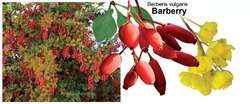
Reddish fruits droop down, greenish-yellow flowers, oval shaped leaves. Contains berberine, an anti-bacterial that fights infection and increases white blood cell count. Berries and roots most common parts used. Berry tea is diuretic, laxative and expectorant. Root bark tea is antiseptic blood cleanser used to clean liver for jaundice, hepatitis, bile production. Also astringent to stop bleeding and hemorrhaging, diarrhea, arthritis. Used for high blood pressure, ulcers, cholera, diarrhea, painful periods, stress, lowers blood pressure and slows breathing. Stimulates gall bladder, liver. Do not use during pregnancy. Because it contains so many strong compounds, don’t overdo it.
Edible Plant Guide © 2012 Markus Rothkranz
The following article is from The Great Soviet Encyclopedia (1979). It might be outdated or ideologically biased.

Barberry


(Berberis), a genus of shrubs of the family Ber-beridaceae.

The leaves of the barberry are simple dentate, arranged in clusters on short branches in the axils of simple or tripartite thorns (modified leaves). The flowers have a double perianth and are yellow, with two nectaries at the base of the petals. The fruit is a berry.

There are approximately 175 species of barberry found mainly in the northern hemisphere. In the USSR, 12 species of barberry grow wild, primarily in the mountainous regions of Middle Asia and in the Caucasus. One species, B. amurensis, grows wild in the Far East. Approximately 45 species have been introduced into the USSR. The barberry is economically important as a berry shrub and a source of honey and dye. The wood of the barberry is very hard and is used for small turned goods. The common barberry (B. vulgaris) is very widely cultivated as a decorative shrub and often planted to form hedges.

An infusion made with the leaves of the common barberry and Amur barberry (containing the alkaloids berberine, oxy-contine, and berbamine) is used for medicinal purposes in cases of uterine hemorrhages (it causes the muscles of the uterus to contract, causes some constriction of the blood vessels, and somewhat accelerates the clotting of the blood). An infusion made with barberry leaves and a sulfate of the alkaloid berberine is used to stimulate the flow of bile in cases of chronic hepatitis, cholecystitis, and gallstones.

Barberry should not be planted near wheat crops because it is the intermediate host of the fungus Puccinia graminis and may infect the grain with wheat rust.

REFERENCES

Derev’ia i kustarniki SSSR. Moscow, 1966.
Shimaniuk, A. P. Dendrologiia. Moscow, 1967.

T. B. VERNANDER

The Great Soviet Encyclopedia, 3rd Edition (1970-1979). © 2010 The Gale Group, Inc. All rights reserved.
Mentioned in
Copyright © 2003-2025 Farlex, Inc Disclaimer
All content on this website, including dictionary, thesaurus, literature, geography, and other reference data is for informational purposes only. This information should not be considered complete, up to date, and is not intended to be used in place of a visit, consultation, or advice of a legal, medical, or any other professional.