Encyclopedia

rooibos

Also found in: Dictionary, Wikipedia.
Enlarge picture
rooibos

rooibos

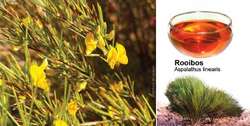
A great antioxidant tea. You know the benefits of green tea, well this is RED tea., which is a mild, slightly sweet tea with antioxidant properties 30 times greater than green tea, and very low levels of tannins, unlike black and green tea. And it is very low in polyphenols, so it will not interfere with other herbs or medications. As with green tea, Rooibos is also anti-cancer. This is in large part due to a chemical in red tea that is very similar in structure, and with the same properties, as superoxide dismutase (SOD), an antioxidant, antiinflammatory and immune stimulatory enzyme produced by cells. SOD also responds to interferons, producing peroxides that help to kill cancer cells, kill pathogens, and activate white blood cells. Used for nervous tension, asthma, allergies, digestive problems, gout, lowering LDL cholesterol and raising HDL cholesterol.
Edible Plant Guide © 2012 Markus Rothkranz
Mentioned in
References in periodicals archive
The native populations of South Africa's Western Cape region, the Bushmen and the Khoisan, have been infusing rooibos leaves and stems for many centuries for the benefits of the shrub's wide-ranging healing properties.
Martin Bergh, chairperson of the SA Rooibos Council (SARC) says it hasn't been easy breaking into the Japanese market, but that Rooibos is starting to make some serious inroads.
There are many health benefits of Red Rooibos, which Crotteau listed a few as:
The native growing region of rooibos is in the Western Cape, centred in the Clanwilliam district, which has a Mediterranean climate and annual winter rainfall of 250-350 mm (Malgas et al.
Research has suggested that the antioxidant effects of rooibos are similar to, if not quite as strong as, those of green tea.
The most abundant flavonoid in rooibos tea (Aspalathus linearis) is aspalathin, a dihydrochalcone C-glycoside.
This means the term Rooibos will be applicable only to products that come from South Africa and are approved by Pretoria, following the massive popularity the herbal tea has acquired in Europe in recent years.
The herbal tea, rooibos, produced from the leaves and stems of Aspalathus linearis, is a well known beverage with a high phenolic content.
He gives the examples of Apple Rooibos, Berry Rooibos, Lemongrass Pai Mu Tan, Peach Pai Mu Tan, Pear Honeybush and Raspberry Honeybush.
Swap your daily coffee for South African rooibos tea, and experience the change in your body.
Rooibos, a native South African herb is mainly consumed as a red herb.
Copyright © 2003-2025 Farlex, Inc Disclaimer
All content on this website, including dictionary, thesaurus, literature, geography, and other reference data is for informational purposes only. This information should not be considered complete, up to date, and is not intended to be used in place of a visit, consultation, or advice of a legal, medical, or any other professional.