Bernoulli principle
(Or "air foil principle", after Swiss mathematician Daniel
Bernoulli, 1700-1782) The law that pressure in a fluid
decreases with the rate of flow. It has been applied to a
class of hard disk drives.
See Bernoulli Box.
See Bernoulli Box.
This article is provided by FOLDOC - Free Online Dictionary of Computing (foldoc.org)
Bernoulli's principle
An increase in the velocity of a fluid that is accompanied by a decrease of pressure. Swiss scientist, Daniel Bernoulli (1700-1782), demonstrated that, in most cases, the pressure in a liquid or gas decreases as the liquid or gas moves faster. This explains in part why a wing lifts an airplane.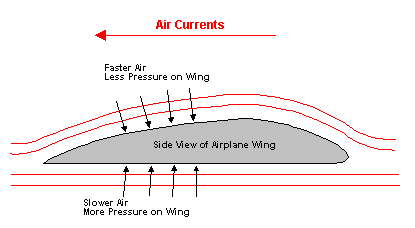 |
| The Lift of a Wing |
|---|
| The curved top of a wing creates a longer distance from front to back than the straight bottom. This causes the air on top to travel farther, and thus faster, to reach the back than the air underneath, creating a difference in pressure between the two surfaces. |
Copyright © 1981-2025 by The Computer Language Company Inc. All Rights reserved. THIS DEFINITION IS FOR PERSONAL USE ONLY. All other reproduction is strictly prohibited without permission from the publisher.