CD-ROM
compact disc read-only memory; a compact disc used with a computer system as a read-only optical disk
Collins Discovery Encyclopedia, 1st edition © HarperCollins Publishers 2005
CD-ROM
[¦sē¦dē ′räm] (computer science)
McGraw-Hill Dictionary of Scientific & Technical Terms, 6E, Copyright © 2003 by The McGraw-Hill Companies, Inc.
CD-ROM
This article is provided by FOLDOC - Free Online Dictionary of Computing (foldoc.org)
CD-ROM
(Compact Disc-Read Only Memory) A type of CD disc that can only be read, but not recorded. Used to store programs and data files, a CD-ROM holds 650MB or 700MB of data and employs a different recording format than the audio CD (CD-DA), from which it evolved. In the 1990s, the CD-ROM rapidly replaced the floppy disk for software distribution.An audio CD player cannot read CD-ROMs, but CD-ROM drives can play audio discs. In practice, the term "CD" refers to all CD formats. The phrase "insert the installation CD" really means "insert the installation CD-ROM."
How CD-ROMs Are Made
CD-ROMs are made by "burning" a blank CD-R disc and sending it to a media manufacturer, which creates a master disc that is used to stamp out the required quantity. See CD-R and mini CD.
Pretty Slow in the Beginning
Back in the late 1980s, the first CD-ROM drives transferred data at 150KB per second. By doubling the spindle speed from 530 to 1,060 RPM, the transfer rate doubled to 300KB (2x). For several years thereafter, speeds increased until reaching 48x and higher, making the "1x" drive painfully slow by comparison. For details about speeds, see CD-ROM drives. Access times range from 80 to 150ms. See CD-R, CD-RW, DVD and optical disc.
 |
| Caddy Load and Tray Load |
|---|
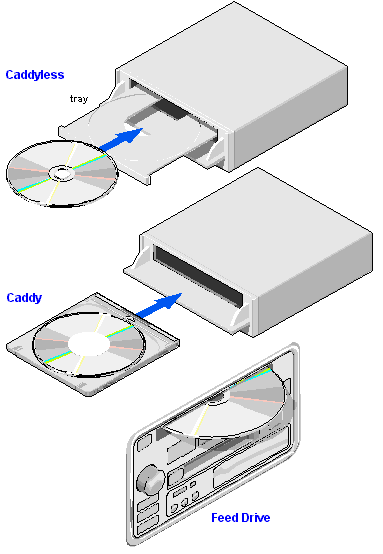
| Earlier drives used a caddy. The disc must be inserted into the caddy, and the caddy inserted into the drive. Today, drives are caddyless. The disc is placed into a tray. |
 |
| Caddy Load and Tray Load |
|---|
| Earlier drives used a caddy. The disc must be inserted into the caddy, and the caddy inserted into the drive. Today, drives are caddyless. The disc is placed into a tray. |
 |
| Reading CDs and CD-ROMs |
|---|
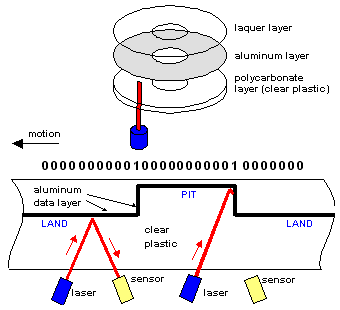
| Digital data are carved into the disc as pits (low spots) and lands (high spots). As the laser shines into the moving pits and lands, a sensor detects a change in reflection when it encounters a transition from pit to land or land to pit. Each transition is a 1. The lack of transitions are 0s. There is only one laser in a drive. Two are used here to illustrate the difference in reflection. |
 |
Copyright © 1981-2025 by The Computer Language Company Inc. All Rights reserved. THIS DEFINITION IS FOR PERSONAL USE ONLY. All other reproduction is strictly prohibited without permission from the publisher.