direct memory access
[də¦rekt ¦mem·rē ′ak‚ses] (computer science)
The use of special hardware for direct transfer of data to or from memory to minimize the interruptions caused by program-controlled data transfers. Abbreviated dma.
McGraw-Hill Dictionary of Scientific & Technical Terms, 6E, Copyright © 2003 by The McGraw-Hill Companies, Inc.
Direct Memory Access
(architecture)(DMA) A facility of some architectures which
allows a peripheral to read and write memory without
intervention by the CPU. DMA is a limited form of bus mastering.
This article is provided by FOLDOC - Free Online Dictionary of Computing (foldoc.org)
DMA
(1) (Digital Media Adapter) See digital media hub.(2) (Document Management Alliance) A specification that provides a common interface for accessing and searching document databases. It provides interoperability between multivendor document management systems. DMA was released in 1998 by the DMA task group of the AIIM association. See AIIM.
(3) (Direct Memory Access) Transferring data between memory and peripheral devices or from memory to memory without going through the CPU. Although DMA technologies may periodically steal cycles from the CPU, data are transferred much faster than using the CPU to control every byte of transfer.
Old ISA buses used 8-bit and 16-bit DMA channels, while PCI can take control and access system memory directly. New Xeon chips call their DMA the I/O Acceleration Technology (IOACT), and ARM's DMA is part of its Advanced Microcontroller Bus Architecture (AMBA) for connecting system-on-chip components (see SOC).
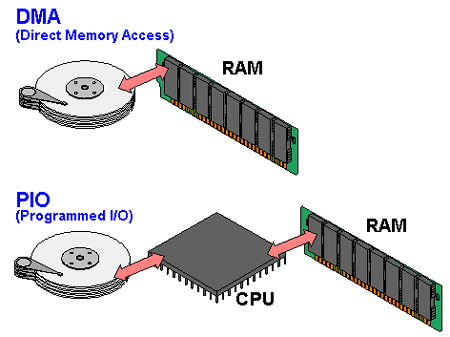 |
| DMA Disk Transfers |
|---|
| IDE disk drives can transfer data via DMA or the Programmed I/O mode. |
Copyright © 1981-2025 by The Computer Language Company Inc. All Rights reserved. THIS DEFINITION IS FOR PERSONAL USE ONLY. All other reproduction is strictly prohibited without permission from the publisher.