TELNET
[′tel‚net] (communications)
McGraw-Hill Dictionary of Scientific & Technical Terms, 6E, Copyright © 2003 by The McGraw-Hill Companies, Inc.
TELNET
/tel'net/ 1. The Internet standard protocol for remote
login. Runs on top of TCP/IP. Defined in STD 8, RFC 854 and extended with options by many other RFCs. Unix
BSD networking software includes a program, telnet, which
uses the protocol and acts as a terminal emulator for the
remote login session. Sometimes abbreviated to TN. TOPS-10
had a similar program called IMPCOM.
2. The US nationwide network into which one dials to access CompuServe. It was created by John Goltz, one of the founders and system guru of CompuServe. He later worked for Tymshare, one of CompuServe's big competitors.
2. The US nationwide network into which one dials to access CompuServe. It was created by John Goltz, one of the founders and system guru of CompuServe. He later worked for Tymshare, one of CompuServe's big competitors.
This article is provided by FOLDOC - Free Online Dictionary of Computing (foldoc.org)
Telnet
A terminal emulation protocol used on the Internet and TCP/IP-based networks. A Telnet program allows a user at a terminal or PC to log in to a remote computer and run a program and execute other Unix commands. Originally developed for ARPAnet, Telnet is a common utility in the TCP/IP protocol suite, but it is not secure and transfers commands in the clear. Secure shell (SSH) provides an encrypted alternative that is widely used (see SSH). See also Telenet.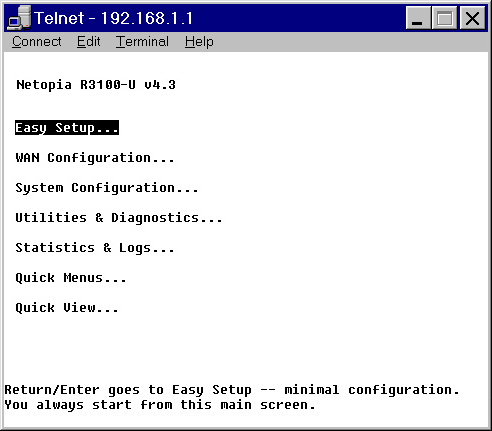 |
| Telnetting from Windows |
|---|
| The Telnet utility in Windows is used to log in to and run programs on servers in local networks as well as the Internet. In this example, Telnet is used for local device management. It is logged into a router to run the device's built-in configuration software. |
Copyright © 1981-2025 by The Computer Language Company Inc. All Rights reserved. THIS DEFINITION IS FOR PERSONAL USE ONLY. All other reproduction is strictly prohibited without permission from the publisher.