central processing unit
central processing unit
[′sen·trəl ′präs‚əs·iŋ ‚yü·nət]central processing unit
(architecture, processor)The control unit fetches instructions from memory and decodes them to produce signals which control the other parts of the computer. These signals cause it to transfer data between memory and ALU or to activate peripherals to perform input or output.
Various types of memory, including cache, RAM and ROM, are often considered to be part of the CPU, particularly in modern microprocessors where a single integrated circuit may contain one or more processors as well as any or all of the above types of memory. The CPU, and any of these components that are in separate chips, are usually all located on the same printed circuit board, known as the motherboard. This in turn is located in the system unit (sometimes incorrectly referred to as the "CPU").
A parallel computer has several CPUs which may share other resources such as memory and peripherals.
The term "processor" has to some extent replaced "CPU", though RAM and ROM are not logically part of the processor.
List of processors.
CPU
(Central Processing Unit) The computing part of the computer. Also called the "processor," the CPU is made up of the control unit, which executes the instructions, and the ALU, which performs the calculations and logical operations. Today, the CPUs of almost all computers are contained on a single microprocessor chip, and multiple processing units on one chip are commonplace (see multicore). See microprocessor, control unit and ALU.Computer vs. Computer System
Technically, the CPU, clock and main memory make up a computer. In addition to the CPU, a complete computer system requires input/output channels, peripheral control units, storage devices and an operating system. In practice, the terms "computer" and "computer system" are synonymous.
From the Mainframer's Viewpoint
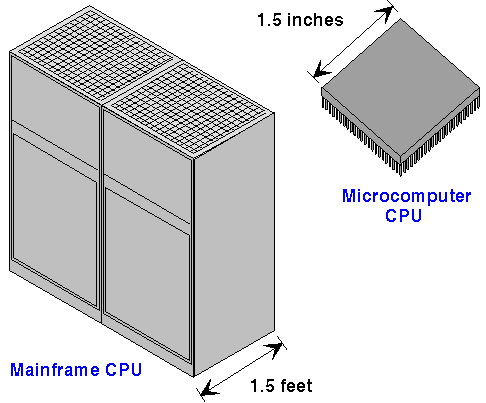
Computer professionals involved with mainframes refer to the entire computer as the CPU.
 |
| Central Processing Units |
|---|
| All computers years ago were called "mainframes," and the CPU referred to the entire computer. Today, a CPU is one chip. |
Central Processing Unit
the central part of a digital computer. It manipulates the data in accordance with the program instructions and exercises control of the entire computation process and of the interaction between the units of the computer. Often called simply the CPU, it is also known as the central processor or the main frame.
The chief parts of the central processing unit are the arithmetic and logical unit (ALU) and the control unit. The control unit determines the sequence in which the instructions are fetched from the memory, produces control signals, coordinates the work of the computer units, processes program interruption signals, provides memory protection, and monitors and diagnoses the operation of the central processing unit. Arithmetic and logical manipulations of data are performed in the ALU. In addition, the central processing unit usually includes a small-capacity high-speed memory unit called the local memory and a number of units designed to organize the computation process, for example, a memory protection unit and a program interruption unit. The working, or main, storage and the channels for communication with peripheral units are constructed as separate devices, although in a small digital computer they may be structurally connected with the central processing unit and may make partial use of its equipment. The central processing unit functions in close interaction with the software, which is, as it were, a continuation of the processor hardware.
The execution of a program involves the sequential performance, in a given order, of arithmetic and logical operations on the words (numbers, codes) stored in the memory and of actions connected with the organization of the computation process and the evaluation of the results obtained. To each operation there usually corresponds one instruction of the program. The central processing unit can therefore be characterized by the set of instructions it can execute (seeINSTRUCTION CODE). The central processing unit operates in repeating cycles. One cycle consists in fetching the instruction and operands and performing the required operations. The most important characteristic of a central processing unit is its operating speed, that is, the time required to execute an instruction or the average number of instructions executed per unit time. When a program is being executed, the use of slow-working (by comparison with the processor) peripheral data input-output units causes the central processing unit to stand idle. This idle time can be reduced through multiprogramming, wherein two or more programs are executed simultaneously.
Multiprocessing computers have more than one processor. The processors that execute data input-output are called peripheral, in contrast to the central processors. The presence of several processors permits faster execution by a digital computer of a single large program or of several smaller programs, including interrelated programs. The structure of the central processing unit and its basic elements determine which generation a digital computer belongs to.
REFERENCES
Flores, I. Organizatsiia vychislitel’nykh mashin. Moscow, 1972. (Translated from English.)Kagan, B. M., and M. M. Knaevskii. Tsifrovye vychislitel’nye mashiny i sistemy, 2nd ed. Moscow, 1973.
Spravochnik po tsifrovoi vychislitel’noi tekhnike. Edited by B. N. Malinovskii. Kiev, 1974.
A. V. GUSEV