device driver
[di′vīs ‚drīv·ər] (computer science)
A subroutine which handles a complete input/output operation.
McGraw-Hill Dictionary of Scientific & Technical Terms, 6E, Copyright © 2003 by The McGraw-Hill Companies, Inc.
device driver
(operating system)Software to control a hardware component
or peripheral device of a computer such as a magnetic disk, magnetic tape or printer.
A device driver is responsible for accessing the hardware registers of the device and often includes an interrupt handler to service interrupts generated by the device.
Device drivers often form part of the lowest level of the operating system kernel, with which they are linked when the kernel is built. Some more recent systems have loadable device drivers which can be installed from files after the operating system is running.
A device driver is responsible for accessing the hardware registers of the device and often includes an interrupt handler to service interrupts generated by the device.
Device drivers often form part of the lowest level of the operating system kernel, with which they are linked when the kernel is built. Some more recent systems have loadable device drivers which can be installed from files after the operating system is running.
This article is provided by FOLDOC - Free Online Dictionary of Computing (foldoc.org)
driver
(1) A loudspeaker. The terms "driver" and "speaker" are used synonymously; however, "the speaker has four drivers" means that the speaker enclosure contains four speakers.(2) A hardware device (typically a transistor) that provides a signal or current to trigger some function. See line driver.
(3) Also called a "device driver," it is a program routine that links the operating system to a peripheral device. Written by programmers who understand the peripheral hardware's command language and characteristics, the driver contains the precise machine language necessary to perform the functions requested by the application.
The Driver Is the Interface
When a new peripheral device is added to the computer, such as a graphics card, its driver must be installed in order to use it. The application calls the operating system, the operating system calls the driver, and the driver makes the device work (it "drives" the device). Routines that perform internal functions, such as memory managers and disk caches, are also drivers.
Drivers Can Drive You Crazy!
Sometimes, the solution to a problem is to update a driver, because the current version has bugs. Hardware vendors are always releasing newer versions. For example, everything you see on screen is the result of the display driver (video driver) drawing the screen according to the commands that the operating system issues to it. Such drivers are extremely complex and can be error prone.
There Used to Be More Drivers
In the early days of DOS PCs, in order to provide complete control over the printing of a document, applications included a driver for each popular printer. That changed when Windows debuted because Windows included the printer drivers. All applications print through the OS, which commands the printer via the one driver for that particular printer. See filter driver and driver signing.
 |
| Windows Display Driver |
|---|
| To display something on screen, a Windows application makes calls to the Graphics Device Interface (GDI). GDI converts the calls to driver functions, and the driver commands the display adapter (graphics card). |
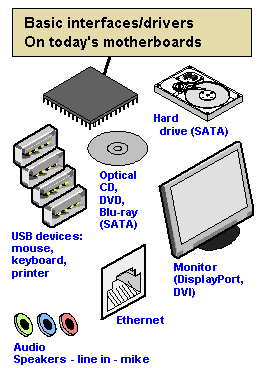 |
| PC Drivers |
|---|
| Every peripheral device requires a driver. The drivers provide the detailed instructions necessary to activate and control the device. |
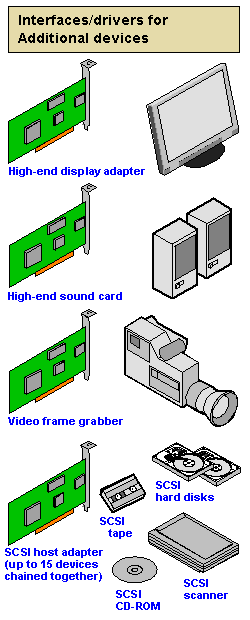 |
| PC Drivers |
|---|
| Every peripheral device requires a driver. The drivers provide the detailed instructions necessary to activate and control the device. |
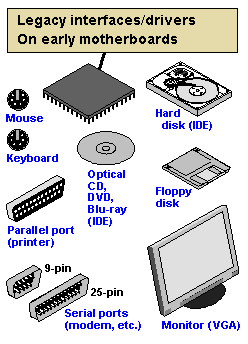 |
| PC Drivers |
|---|
| Every peripheral device requires a driver. The drivers provide the detailed instructions necessary to activate and control the device. |
Copyright © 1981-2025 by The Computer Language Company Inc. All Rights reserved. THIS DEFINITION IS FOR PERSONAL USE ONLY. All other reproduction is strictly prohibited without permission from the publisher.