lambda
(λ) 1. The 11th letter of the Greek alphabet, used in stellar nomenclature usually to designate the 11th-brightest star in a constellation or sometimes to indicate a star's position in a group.
2. Symbol for wavelength or longitude.
Collins Dictionary of Astronomy © Market House Books Ltd, 2006
lambda
[′lam·də] (mechanics)
A unit of volume equal to 10-6 liter or 10-9 cubic meter.
McGraw-Hill Dictionary of Scientific & Technical Terms, 6E, Copyright © 2003 by The McGraw-Hill Companies, Inc.
lambda
Greek letter adopted as symbol by gay liberation movement. [Am. Pop. Cult.: Misc.]
See: Homosexuality
Allusions—Cultural, Literary, Biblical, and Historical: A Thematic Dictionary. Copyright 2008 The Gale Group, Inc. All rights reserved.
LAMBDA
A version of typed lambda-calculus, used to describe
semantic domains.
["Outline of a Mathematical Theory of Computation", D.S. Scott, TM PRG-2, PRG, Oxford U, 1971].
["Outline of a Mathematical Theory of Computation", D.S. Scott, TM PRG-2, PRG, Oxford U, 1971].
This article is provided by FOLDOC - Free Online Dictionary of Computing (foldoc.org)
lambda
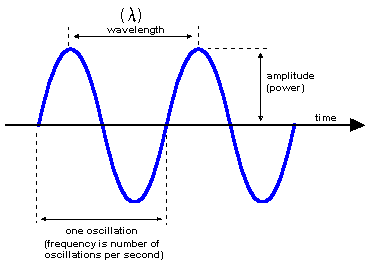
(1) See AWS Lambda.(2) The Greek letter "L," which is used as a symbol for "wavelength." A lambda is a particular frequency of light, and the term is widely used in optical networking. Sending "multiple lambdas" down a fiber is the same as sending "multiple frequencies" or "multiple colors." See WDM and wavelength.
 |
| Lambda |
|---|
| The symbol above the word "wavelength" in this diagram is the Greek Lambda. |
Copyright © 1981-2025 by The Computer Language Company Inc. All Rights reserved. THIS DEFINITION IS FOR PERSONAL USE ONLY. All other reproduction is strictly prohibited without permission from the publisher.