logic gate
[′läj·ik ‚gāt] (computer science)
McGraw-Hill Dictionary of Scientific & Technical Terms, 6E, Copyright © 2003 by The McGraw-Hill Companies, Inc.
logic gate
An integrated circuit or other device whose inputs and
outputs represent Boolean or binary values as voltages
(TTL uses 0V for False or 0, +5V for True or 1). Different
gates implement different Boolean functions: AND, OR,
NAND, NOR (these may take two or more inputs) NOT (one
input), XOR (two inputs). NOT, NAND and NOR are often
constructed from single transistors and the other gates made
from combinations of these basic ones. These functions are
all combinatorial logic functions, i.e. their outputs depend
only on their inputs and there is no internal state. Gates
with state, such as latches and flip-flops, are
constructed by feeding some of their outputs back to their
inputs.
This article is provided by FOLDOC - Free Online Dictionary of Computing (foldoc.org)
logic gate
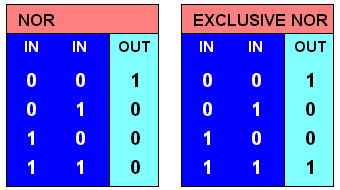
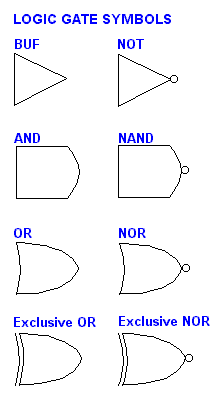
A collection of transistors and resistors that implement Boolean logic operations in a circuit. Transistors make up logic gates. Logic gates make up circuits. Circuits make up electronic systems. The truth tables and symbols follow. See Boolean logic.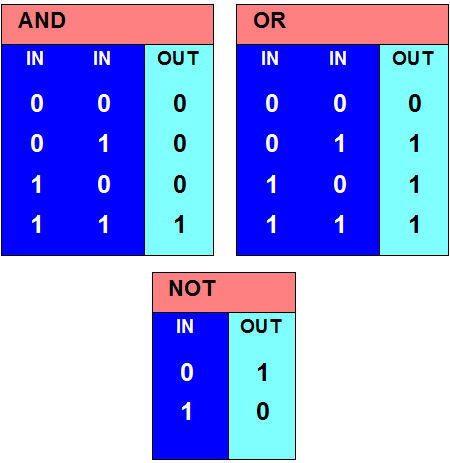 |
 |
 |
 |
 |
 |
Copyright © 1981-2025 by The Computer Language Company Inc. All Rights reserved. THIS DEFINITION IS FOR PERSONAL USE ONLY. All other reproduction is strictly prohibited without permission from the publisher.