main loop
[′mān ‚lüp] (computer science)
A set of instructions that constitute the primary structure of a repetitive computer program.
McGraw-Hill Dictionary of Scientific & Technical Terms, 6E, Copyright © 2003 by The McGraw-Hill Companies, Inc.
main loop
(programming)The top-level control flow construct in an
input- or event-driven program, the one which receives and
acts or dispatches on the program's input events.
See also driver.
See also driver.
This article is provided by FOLDOC - Free Online Dictionary of Computing (foldoc.org)
main loop
The primary logic in a program, which is input-process-output. In an online, interactive program, everything happens when an input occurs, such as a mouse click, mouse movement, keyboard depression or arriving network packet. The main loop takes care of this by continually testing for these inputs and calling the appropriate routines to process them. Outputs are the data on screen and updated files.In a batch processing program where data are processed without human interaction, the main loop reads the next record and processes it. Output is often continuously updated files with summaries displayed at the end. See loop and event loop.
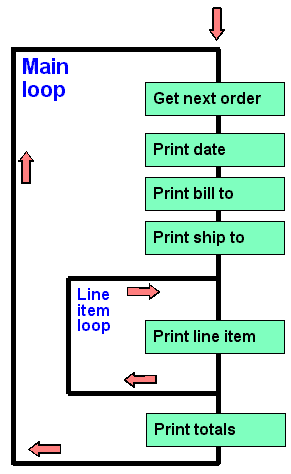 |
| A Batch Processing Print Job |
|---|
| This example reads order records and prints invoices. After printing date and bill-to/ship-to data, the program prints a variable number of line items. The line item routine is a subloop within the main loop. |
Copyright © 1981-2025 by The Computer Language Company Inc. All Rights reserved. THIS DEFINITION IS FOR PERSONAL USE ONLY. All other reproduction is strictly prohibited without permission from the publisher.