precession of the equinoxes
The slow continuous westward motion of the equinoxes around the ecliptic that results from the precession of the Earth's axis. It was first described by Hipparchus in the second century bc. As the axis precesses, the celestial equator, which lies in the plane perpendicular to the axis, moves relative to the ecliptic. The two points at which the planes intersect – the equinoxes – thus move round the ecliptic in the precessional period of about 25 800 years, the annual rate being about 50.27 arc seconds. Coordinates such as right ascension that refer to an equinox as their zero point thus change with time. Star catalogs therefore use a catalog equinox as their origin.Collins Dictionary of Astronomy © Market House Books Ltd, 2006
precession of the equinoxes
[prē′sesh·ən əvthə ′ē·kwə‚näk·səz] (astronomy)
A slow conical motion of the earth's axis about the vertical to the plane of the ecliptic, having a period of 26,000 years, caused by the attractive force of the sun, moon, and other planets on the equatorial protuberance of the earth; it results in a gradual westward motion of the equinoxes.
McGraw-Hill Dictionary of Scientific & Technical Terms, 6E, Copyright © 2003 by The McGraw-Hill Companies, Inc.
precession of the equinoxes
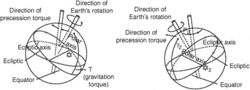

In the illustration, the equatorial plane changes its orientation in space as North Pole (P) rotates. The first point of Aries and Libra, alternatively known as the Spring and Autumnal Equinoxes, precess westerly at a mean rate of 5.26 s of arc. The true pole completes one circuit of the ecliptic in 25,800 years.
An Illustrated Dictionary of Aviation Copyright © 2005 by The McGraw-Hill Companies, Inc. All rights reserved