punched card
(esp US), punch cardpunch card
[′pənch ‚kärd]punch card
punch card
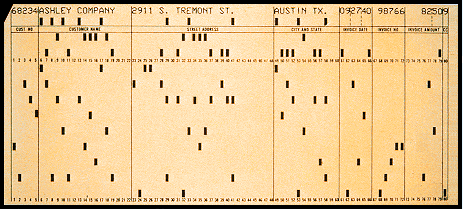
(1) See loyalty punch card.(2) An early storage medium made of thin cardboard stock that held data as patterns of punched holes. Also called "punched" cards, each of the 80 or 96 columns held one character. The holes were punched by an operator at a keypunch machine or by an attached card punch peripheral. The cards were fed into the computer by a card reader.
From 1890 Until the 1970s
Punch cards were synonymous with data processing for 80 years. Concepts were simple: the database was the file cabinet; a record was a card, and processing was performed on separate machines called "sorters," "collators," "reproducers," "calculators" and "accounting machines." After the 1950s, business transactions were punched into cards and fed to a computer to update the electronic files, first on tape and then on disk.
Gone But Not Forgotten
Today, the punch card is obsolete; however, some voting systems used the punch-card method until 2014. The presidential election of 2000 brought punch cards into infamy and made the U.S. the brunt of jokes worldwide for using such an antiquated error-prone system. The solution in many states was to migrate to electronic voting machines, which were developed without audit trails that prevented ballots from being recounted in close elections. So much for progress! See e-voting, sorter, tabulator, accounting machine, plugboard and Hollerith machine.
 |
| IBM Punch Card |
|---|
| Stemming from Hollerith's punch card tabulating system in 1890, punch cards "were" synonymous with data processing for more than 70 years. IBM and Sperry Rand were the two major providers of equipment. This 80-column IBM card shows a typical customer master record. |
 |
| Jacquard Loom Inspiration |
|---|
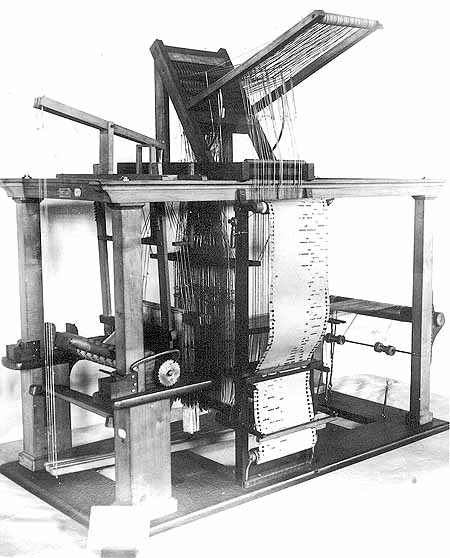
| In operation decades before, the Jacquard loom was inspiration for Hollerith's machines. See Jacquard loom. (Image courtesy of The Computer History Museum, www.computerhistory.org) |
Punch Card
(or punched card), a recording medium in the form of a card made of paper, paperboard, or, more rarely, plastic and of a standard shape and size; data are recorded on the card by the punching of holes. Punch cards are used primarily for the input and output of data in computers and as the basic recording medium in punch-card processing equipment. They exist in many types, which differ in shape, size, volume of information stored, and the shape and arrangement of the holes. Most of the punch cards used in the USSR have 80 columns—45-column cards are encountered in obsolete computer units—and are made of heavy paper stock 0.18 mm thick in the shape of a rectangle with sides of 187.4 and 82.5 mm. The top left corner of the card is cut off for convenience in sorting and stacking. The columns are marked off across the card from left to right. The card is also divided into 12 rows—10 primary and 2 supplementary. Up to 80 characters—approximately 10 to 15 words—can be recorded on one punch card. The processing rate for machine punch cards can reach 2,000 cards/min. Data are read by means of electromechanical readers or photoelectric cells. Punch cards with 90, 40, and 21 columns and 6, 12, and 10 rows, respectively, are also used in other countries. Special forms of punch cards are edge-punched cards, which are used in information systems, and cards for automatic typewriters.
REFERENCES
Roomets, S. Perfokarty i ikh primenenie. Tallinn, 1965.Anisimov, B. V., and K. S. Khomiakov. Ustroistva podgotovki dannykh dlia elektronnykh vychislitel’nykh mashin. Moscow, 1972.