rendering
[′ren·dər·iŋ] (graphic arts)
Methods or techniques that are used to display realistic-looking three-dimensional images on a two-dimensional medium such as a computer display.
McGraw-Hill Dictionary of Scientific & Technical Terms, 6E, Copyright © 2003 by The McGraw-Hill Companies, Inc.
rendering
1. A drawing, especially a perspective of a building or interior space, artistically delineating materials, shades and shadows, done for the purpose of presentation and persuasion.

See also: Design drawing
2. A coat of plaster applied directly to an interior wall or stucco on an exterior wall; a perspective or elevation drawing of a project or portion thereof with artistic delineation of materials, shades, and shadows. See also: Plaster
Illustrated Dictionary of Architecture Copyright © 2012, 2002, 1998 by The McGraw-Hill Companies, Inc. All rights reserved
rendering
1. Applying a coat of plaster directly on an interior wall or stucco on an exterior wall.
2. A perspective or elevation drawing of a project or portion thereof with artistic delineation of materials, shades, and shadows.
McGraw-Hill Dictionary of Architecture and Construction. Copyright © 2003 by McGraw-Hill Companies, Inc.
rendering
(graphics, text)The conversion of a high-level object-based
description into a graphical image for display.
For example, ray-tracing takes a mathematical model of a three-dimensional object or scene and converts it into a bitmap image. Another example is the process of converting HTML into an image for display to the user.
For example, ray-tracing takes a mathematical model of a three-dimensional object or scene and converts it into a bitmap image. Another example is the process of converting HTML into an image for display to the user.
This article is provided by FOLDOC - Free Online Dictionary of Computing (foldoc.org)
browser engine
The underlying software that turns HTML pages into the Web page the user sees. A browser engine includes the programming interface (API) and the rendering engine, which converts HTML and JavaScript into text and images for the screen and printer. Also called a "layout engine," a browser engine is also used by email programs that support HTML (most do), as well as other applications that render Web content. Following is a sampling of popular browsers. See API, HTML, JavaScript, HTML email and render.Browser RenderingBrowser Engine Engine Internet Explorer Trident Trident AOL Explorer Trident Trident Firefox Gecko Gecko Safari Webkit WebKit Chrome as of V28 Chromium Blink Chrome up to V27 Chromium WebKit Edge as of V80 Chromium Blink Edge up to V79 Microsoft EdgeHTML Opera as of V15 Chromium Blink Opera up to V14 Opera Presto Konqueror KHTML KHTML Brave Chromium Blink Vivaldi Chromium Blink Android browsers Chromium Blink iOS browsers Chromium WebKit Flow Flow Flow
browser rendering engine
Software that renders HTML pages (Web pages). A browser rendering engine turns content coded in HTML into the text and images for the screen and printer. Also called a "layout engine," a rendering engine is used by Web browsers, email programs (for HTML email) and other applications that render HTML content. Following is a sampling of popular browsers and their rendering engines. See HTML, HTML email and render.RenderingBrowser Engine Source Internet Explorer Trident Microsoft AOL Explorer Trident Microsoft Firefox Gecko Mozilla Safari WebKit Apple Chrome up to V27 WebKit Apple Chrome as of V28 Blink Chromium Edge up to V79 EdgeHTML Microsoft Edge as of V80 Blink Chromium Opera up to V14 Presto Opera Opera as of V15 Blink Chromium Konqueror KHTML KHTML Brave Blink Chromium Vivaldi Blink Chromium Android browsers Blink Chromium iOS browsers WebKit Apple
render
(1) To make visible; to draw. The term render comes from the graphics world where a rendering is an artist's drawing of what a new structure would look like. In computer-aided design (CAD), a rendering is a particular view of a 3D model that has been converted into a realistic image. It includes basic lighting such as Gouraud shading as well as more sophisticated effects that simulate shadows, reflection and refraction. It may also include the application of textures to the surfaces. See Gouraud shading, Phong shading, texture mapping, ray tracing and rapid prototyping.(2) To convert any coded content to the required format for display or printing. Although the term is typically used to refer to images, it may refer to any data. For example, an HTML page, which contains text and graphics, is said to be "rendered" when it is displayed. See browser engine.
 |
| A Bentley Rendering |
|---|
| Photorealistic pictures require high-end rendering software. This drawing of downtown Philadelphia was rendered in MicroStation MasterPiece from Bentley Systems. (Image courtesy of Bentley Systems, Inc.) |
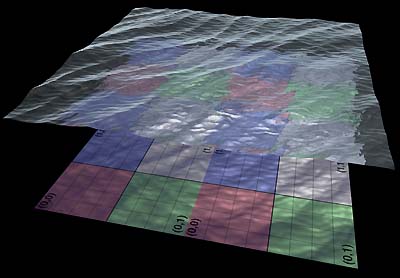 |
| A Pixar Rendering |
|---|
| Pixar's sophisticated RenderMan software was used to simulate water in this example. (Image courtesy of Pixar Animation Studios.) |
Copyright © 1981-2025 by The Computer Language Company Inc. All Rights reserved. THIS DEFINITION IS FOR PERSONAL USE ONLY. All other reproduction is strictly prohibited without permission from the publisher.