Encyclopedia

clustering

Also found in: Dictionary, Medical, Idioms, Wikipedia.

clustering

This article is provided by FOLDOC - Free Online Dictionary of Computing (foldoc.org)

clustering

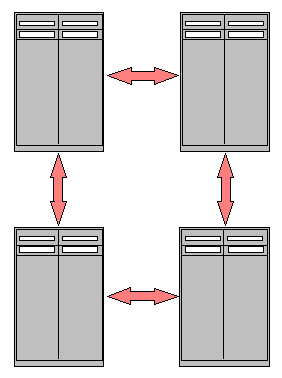
Using two or more computer systems that work together. It generally refers to multiple servers that are linked together in order to handle variable workloads or to provide continued operation in the event one fails. Each computer is a multiprocessor system itself. For example, a cluster of four computers, each with 16 CPU cores, would enable 64 unique processing threads to take place simultaneously.

Clustering
A cluster of servers provides fault tolerance and/or load balancing. If one server fails, one or more servers are still available. Load balancing distributes the workload over multiple systems.
Copyright © 1981-2025 by The Computer Language Company Inc. All Rights reserved. THIS DEFINITION IS FOR PERSONAL USE ONLY. All other reproduction is strictly prohibited without permission from the publisher.
Mentioned in
References in periodicals archive
The LC function permits overtaking behaviors, which decrease the mobility dependency between vehicles, and thus degrade the performance of clustering algorithms based on mobility metrics.
Experiments were also conducted to investigate the effects of the cluster radius in hops (i.e., the value of d) on clustering performance.
Initial clustering of vehicles is made based on the location and using rough set theory vehicles are categorized to be in the lower and upper approximations.
Single and double clusters are almost meaningless in the viewpoint of clustering and we call them as bad clusters.
The most popular example of density-based clustering is DBSCAN in which only the objects whose density is greater than the given thresholds are connected together to form a cluster.
The commonly used seismicity partitioning methods include the K-Means cluster, the hierarchical cluster, the self-organizing maps (SOM), the fuzzy cluster, the Gaussian mixture model (GMM), the density-based clustering algorithm (DBSCAN), and some other cluster means, which have been listed in Table 1.
Data clustering is a data mining and data analysis method, that produces refined views to the in-built structure of a data set by separating it into a number of disjoints or overlapping classes.
Fuzzy set theory has played an important role in many applications, such as fuzzy clustering analysis, fuzzy pattern recognition [13], fuzzy synthetic judgments [14], fuzzy decision and forecast [15, 16], fuzzy programming, fuzzy probability [17], and fuzzy statistics [18].
Copyright © 2003-2025 Farlex, Inc Disclaimer
All content on this website, including dictionary, thesaurus, literature, geography, and other reference data is for informational purposes only. This information should not be considered complete, up to date, and is not intended to be used in place of a visit, consultation, or advice of a legal, medical, or any other professional.