integrated circuit
integrated circuit
[′int·ə‚grād·əd ′sər·kət]integrated circuit
(electronics)Integrated circuits can be classified into analogue, digital and hybrid (both analogue and digital on the same chip). Digital integrated circuits can contain anything from one to millions of logic gates - inverters, AND, OR, NAND and NOR gates, flip-flops, multiplexors etc. on a few square millimeters. The small size of these circuits allows high speed, low power dissipation, and reduced manufacturing cost compared with board-level integration.
The first integrated circuits contained only a few transistors. Small Scale Integration (SSI) brought circuits containing transistors numbered in the tens. Later, Medium Scale Integration (MSI) contained hundreds of transistors. Further development lead to Large Scale Integration (LSI) (thousands), and VLSI (hundreds of thousands and beyond). In 1986 the first one megabyte RAM was introduced which contained more than one million transistors.
LSI circuits began to be produced in large quantities around 1970 for computer main memories and pocket calculators. For the first time it became possible to fabricate a CPU or even an entire microprocesor on a single integrated circuit. The most extreme technique is wafer-scale integration which uses whole uncut wafers as components.
integrated circuit
The formal name of the chip. An integrated circuit (IC) combines multiple transistors, resistors and capacitors on a single substrate. Prior to integrated circuits, these electronic components were discrete devices wired to each other on a printed circuit board.In 1958, Texas Instruments inventor Jack Kilby demonstrated the concept. Although integrated circuits did not become commercialized until Robert Noyce of Fairchild Semiconductor developed his silicon-based device a couple months later, Kilby's circuit proved that multiple electronic devices could be constructed as a single unit. See chip, microcontroller and transistor.
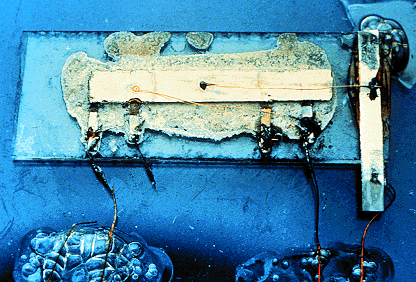 |
| The First Integrated Circuit |
|---|
| Demonstrated by TI in September 1958, this half-inch wide, archaic-looking collection of transistor, capacitor and two resistors mounted on a bar of germanium was the first IC. (Image courtesy of Texas Instruments, Inc.) |
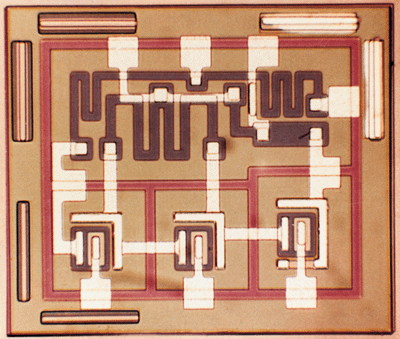 |
| Seven Years Later - Three Transistors |
|---|
| This amplifier circuit from Siemens was mass produced in 1965. Containing three transistors and five resistors on a 1.5 square millimeter chip, it was a world of sophistication compared to Kilby's invention. (Image courtesy of Siemens AG, www.siemens.com) |
 |
| A Half Century Later - 35 Billion Transistors |
|---|
| Xilinx's Versal chip includes multiple CPUs, RAM and an FPGA section comprising configurable circuits (see FPGA and Versal). |
Integrated Circuit
(also integrated microcircuit), a microminiaturized electronic device, all or some of whose components are inseparably structurally linked and are interconnected electrically. There are two basic types: semiconductor integrated circuits and thin-film integrated circuits.
Semiconductor integrated circuits (Figure 1) are manufactured from extremely pure semiconductor materials (usually silicon or germanium), whose crystal lattice is modified in such a way that individual regions of a crystal become components of a complex circuit. A small chip of crystalline material, with an area of about 1 sq mm, becomes a very complex electronic device, equivalent to a radio engineering unit of 50–100 or more conventional components. Such a device is capable of amplifying or generating signals and of functioning in many other radio engineering applications.
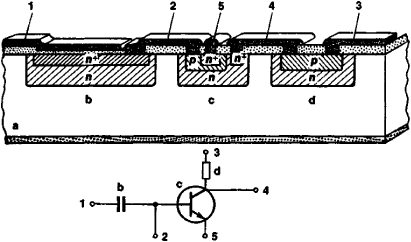
The manufacturing technology of semiconductor integrated circuits makes possible the simultaneous multiple production of large numbers of circuits. This determines the identity of circuit properties. Semiconductor circuits have high reliability because of the use of the planar manufacturing process and a significant reduction in the number of microscopic connections of components in the manufacturing process.
Semiconductor integrated circuits are developing in the direction of increasing concentration of components in the same volume of semiconductor crystal (toward a higher degree of integration). Integrated circuits with hundreds and thousands of components in a single crystal have been developed. In such a case an integrated circuit becomes a complex integrated system. Such a system can be developed and manufactured only with the aid of high-output electronic computers.
Thin-film integrated circuits are made by deposition of various materials at a low pressure (on the order of l X 105 mm of mercury [mm Hg]) as thin films (less than 1 micron [M] thick) or thick films (more than 1 μ thick). The film is deposited on a polished substrate, usually a ceramic, that has been preheated to a particular temperature. Materials used for the film include aluminum, gold, titanium, nichrome, tantalum oxide, silicon monoxide, barium titanate, and tin oxide. To produce integrated circuits with specific functions, multilayer thin-film structures are created by deposition of materials with the required properties on the substrate through a mask or stencil. In such structures one of the layers contains microresistors, another layer contains microcapacitors, and several other layers contain interconnecting current conductors and other components. All components in these layers are interconnected in an arrangement characteristic of the particular electronic device.
Thin-film components are widely used in hybrid integrated circuits (Figure 2). In such systems the passive components (resistors, capacitors, and conductors) are deposited first on the substrate as thin or thick films, and then the active semiconductor microcomponents (nude transistors and diodes) are mounted with the aid of micromanipulators.

Semiconductor and hybrid integrated circuits are complementary in terms of design and electrical characteristics; they can be used simultaneously in identical radioelectronic units. Integrated circuits are mounted in casings that protect them from external influences. Integrated circuits are categorized according to the number of components: first degree of integration (up to 10 components), second degree of integration (10–100), and so on.
The dimensions of the individual components of an integrated circuit are very small (on the order of 0.5-10.Oμ) and are sometimes commensurate with the dimensions of dust particles (1–100 μ). Therefore, the manufacture of integrated circuits is conducted under extremely clean conditions.
There are several trends in the design of integrated circuits, including hybrid circuits, with discrete active components; semiconductor circuits made in a single block of semiconductor material; combined circuits, in which the active components are made in a single block of semiconductor material and the passive components are deposited as thin films; and thin-film circuits, where both the active and passive components are deposited on the substrate as thin films.
REFERENCES
Kolosov, A. A., Iu. I. Gorbunov, and Iu. E. Naumov. Poluprovodnikovye tverdye schemy. Moscow, 1965.Integral’nye skhemy: Prinlsipy konslruirovaniia iproizvodstva. Edited by A. A. Kolosov. Moscow, 1968. (Translated from English.)
Integral’nye skhemy: Osnovy proektirovaniia i technologii. Edited by K. I. Martiushov. Moscow, 1970. (Translated from English.)
I. E. EFTMOV