mean Sun
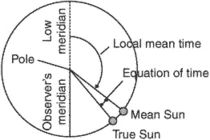
An abstract reference point that was introduced to define mean solar time. It has a constant rate of motion and is used in timekeeping in preference to the real Sun whose observed motion is nonuniform. This nonuniformity results primarily from the Earth's elliptical orbit around the Sun, which causes the Earth's orbital speed, and hence the Sun's apparent speed, to vary (see Kepler's laws). Secondly the direction of the Sun's apparent motion is along the ecliptic and is thus inclined to the direction parallel to the celestial equator along which solar time is measured. An additional seasonal variation is therefore introduced when the Sun's motion is measured relative to the equator.The mean Sun follows a circular orbit around the celestial equator so that it moves eastward at a constant speed and completes one circuit in the same time – one tropical year – as the apparent Sun takes to orbit the ecliptic, if the slight secular acceleration of the Sun is ignored. The mean Sun is defined by an expression for its right ascension, which fixes its position among the stars at every instant.
mean sun
[′mēn ′sən]mean sun
Mean Sun
a fictitious point on the celestial sphere that moves uniformly along the celestial equator and crosses the vernal equinox at intervals of a tropical year. The mean sun is used in measuring mean solar time. The concept of the mean sun was introduced in the 18th century to make the measurement of daily time more accurate.
Owing to the eccentricity of the earth’s orbit and the obliquity of the ecliptic, along which the apparent annual motion of the sun occurs, the length of the apparent, or true, solar day—that is, the time interval between successive upper transits of the apparent, or true, sun—varies by as much as 50 seconds in the course of a year. The concept of the mean sun was introduced to eliminate this lack of uniformity. What is known as the equation of time is taken into account when determining mean solar time from observations of the sun. The equation of time is the difference between the right ascensions of the apparent sun and the mean sun. Alternatively, the equation of time can be defined as the difference between the hour angles of the apparent and mean suns.