microprocessor
Computing a single integrated circuit performing the basic functions of the central processing unit in a small computer
Collins Discovery Encyclopedia, 1st edition © HarperCollins Publishers 2005
microprocessor
[¦mī·krō′prä‚ses·ər] (electronics)
A single silicon chip on which the arithmetic and logic functions of a computer are placed.
McGraw-Hill Dictionary of Scientific & Technical Terms, 6E, Copyright © 2003 by The McGraw-Hill Companies, Inc.
microprocessor
(architecture)(Or "micro") A computer whose entire CPU is
contained on one (or a small number of) integrated circuits.
The important characteristics of a microprocessor are the widths of its internal and external address bus and data bus (and instruction), its clock rate and its instruction set. Processors are also often classified as either RISC or CISC.
The first commercial microprocessor was the Intel 4004 which appeared in 1971. This was the CPU member of a set of four LSI integrated circuits called the MCS-4, which was originally designed for use in a calculator but was marketed as "programmable controller for logic replacement". The 4004 is referred to as a 4-bit microprocessor since it processed only 4 bits of data at a time. This very short word size is due mainly to the limitations imposed by the maximum integrated circuit density then achievable.
As integrated circuit densities increased with the rapid development of integrated circuit manufacturing technology, the power and performance of the microprocessors also increased. This is reflected in the increase in the CPU word size to 4, 8, 16, and by mid-1980s, 32 bits. The smaller microprocessors have relatively simple instruction sets, e.g., no floating point instructions, but they are nevertheless suitable as controllers for a very wide range of applications such as car engines and microwave ovens.
The Intel 4004 was followed with, among others the 4040, 8008, 8080, 8086, 80186, 80286, 80386, 486 and Pentium. Other families include the Motorola 6800 and 680x0 families, National Semiconductor 16000 and National Semiconductor 32000, SPARC, ARM, MIPS, Zilog Z8000, PowerPC and the Inmos Transputer family.
The larger, more recent microprocessors families have gradually acquired most of the features of large computers. As the microprocessor industry has matured, several families of microprocessors have evolved into de facto industrial standards with multiple manufacturers and numerous "support" chips including RAM, ROM, I/O controllers etc.
A single chip microprocessor may include other components such as memory (RAM, ROM, PROM), memory management, caches, floating-point unit, input/output ports and timers. Such devices are also known as microcontrollers.
The one-chip microcomputer is in many respects, a landmark development in computer technology because it reduces the computer to a small, inexpensive, and easily replaceable design component.
Microcomputers have given rise to a new class of general-purpose machines called personal computers. These are small low cost computers that are designed to sit on an ordinary office desk or to be portable and fuelled the computer boom of the late 1980s. The most widespread example is the also IBM PC, based on microprocessors from Intel Corporation. Apple Computers, Inc. have also produced a range of personal computers, as have several other companies.
See also killer micro, minicomputer, CPU Info Center.
The important characteristics of a microprocessor are the widths of its internal and external address bus and data bus (and instruction), its clock rate and its instruction set. Processors are also often classified as either RISC or CISC.
The first commercial microprocessor was the Intel 4004 which appeared in 1971. This was the CPU member of a set of four LSI integrated circuits called the MCS-4, which was originally designed for use in a calculator but was marketed as "programmable controller for logic replacement". The 4004 is referred to as a 4-bit microprocessor since it processed only 4 bits of data at a time. This very short word size is due mainly to the limitations imposed by the maximum integrated circuit density then achievable.
As integrated circuit densities increased with the rapid development of integrated circuit manufacturing technology, the power and performance of the microprocessors also increased. This is reflected in the increase in the CPU word size to 4, 8, 16, and by mid-1980s, 32 bits. The smaller microprocessors have relatively simple instruction sets, e.g., no floating point instructions, but they are nevertheless suitable as controllers for a very wide range of applications such as car engines and microwave ovens.
The Intel 4004 was followed with, among others the 4040, 8008, 8080, 8086, 80186, 80286, 80386, 486 and Pentium. Other families include the Motorola 6800 and 680x0 families, National Semiconductor 16000 and National Semiconductor 32000, SPARC, ARM, MIPS, Zilog Z8000, PowerPC and the Inmos Transputer family.
The larger, more recent microprocessors families have gradually acquired most of the features of large computers. As the microprocessor industry has matured, several families of microprocessors have evolved into de facto industrial standards with multiple manufacturers and numerous "support" chips including RAM, ROM, I/O controllers etc.
A single chip microprocessor may include other components such as memory (RAM, ROM, PROM), memory management, caches, floating-point unit, input/output ports and timers. Such devices are also known as microcontrollers.
The one-chip microcomputer is in many respects, a landmark development in computer technology because it reduces the computer to a small, inexpensive, and easily replaceable design component.
Microcomputers have given rise to a new class of general-purpose machines called personal computers. These are small low cost computers that are designed to sit on an ordinary office desk or to be portable and fuelled the computer boom of the late 1980s. The most widespread example is the also IBM PC, based on microprocessors from Intel Corporation. Apple Computers, Inc. have also produced a range of personal computers, as have several other companies.
See also killer micro, minicomputer, CPU Info Center.
This article is provided by FOLDOC - Free Online Dictionary of Computing (foldoc.org)
microprocessor
A central processing unit (CPU) contained within a single chip (integrated circuit). The term originated in the 1970s when processors were first miniaturized. Today, all CPUs are microprocessors, and server, desktop, laptop, smartphone and tablet microprocessors have more than one processing core (see multicore).The terms central processing unit (CPU), processor, microprocessor (MP) and microprocessor unit (MPU) are synonymous. The MP acronym is sometimes spelled "uP" or "µP" (lower case "m" in Greek is a "µ").
From 8-Bit to 64-Bit
The earliest microprocessors were created by Texas Instruments, Intel and Scotland-based Pico Electronics, but who was really first has been debated. First-generation 8-bit microprocessor families were Intel's 8080, Zilog's Z80, Motorola's 6800 and Rockwell's 6502.
Today, the 32-bit and 64-bit microprocessors found in workstations and servers are x86, POWER and SPARC, while ARM leads the mobile market. The chips used in toys, appliances, vehicles and myriad other products are 8-, 16- and 32-bit microcontrollers, which include the microprocessor (see microcontroller). All together billions of microprocessors are made and shipped each year. See chip, embedded system, process technology, 16-bit computing, 32-bit computing and 64-bit computing.
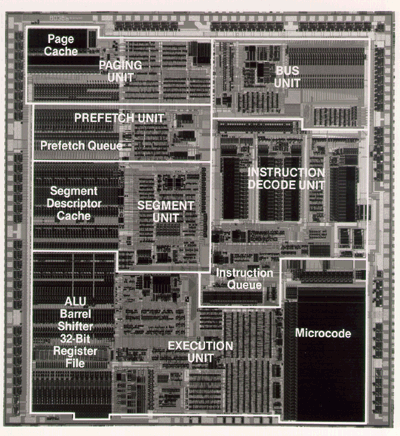 |
| The 386 Microprocessor |
|---|
| No technology is more incredible than the microprocessor. This older 386 chip contains a mere 275,000 transistors, and some slight detail can be seen. Contemporary chips at this magnification level show up only as a sea of gray. See chip. (Image courtesy of Intel Corporation.) |
 |
| From Two Thousand to Nineteen Billion |
|---|
| This is only a sampling of the number of transistors on a chip. Other brands have similar transistor counts. |
Copyright © 1981-2025 by The Computer Language Company Inc. All Rights reserved. THIS DEFINITION IS FOR PERSONAL USE ONLY. All other reproduction is strictly prohibited without permission from the publisher.