register
Register
register
[′rej·ə·stər]register

register
(1)There are only a small number of registers (the "register set"), typically 32 in a modern processor though some, e.g. SPARC, have as many as 144. A register may be directly addressed with a few bits. In contrast, there are usually millions of words of main memory (RAM), requiring at least twenty bits to specify a memory location. Main memory locations are often specified indirectly, using an indirect addressing mode where the actual memory address is held in a register.
Registers are fast; typically, two registers can be read and a third written -- all in a single cycle. Memory is slower; a single access can require several cycles.
The limited size and high speed of the register set makes it one of the critical resources in most computer architectures. Register allocation, typically one phase of the back-end, controls the use of registers by a compiled program.
See also accumulator, FUBAR, orthogonal, register dancing, register allocation, register spilling.
register
(2)register
(1) To sign up. See registration.(2) A small, high-speed computer circuit that holds values of internal operations, such as the address of the instruction being executed and the data being processed. When a program is debugged, register contents may be analyzed to determine the computer's status at the time of failure.
In microcomputer assembly language programming, programmers look at the contents of registers routinely. Assembly languages in larger computers are often at a higher level.
Register
a device for recording the text of telegrams received in Morse code. A relief register uses a metal pin to press raised Morse symbols into a paper tape. An inkwriter prints in black ink on a paper tape, using either a writing wheel to draw dashes or a pen to trace zigzags. B. S. Iakobi designed the first practical relief register with an electromagnet in 1839. Relief registers were used extensively in Russia until the early 1870’s, when Morse inkwriters and (later) siphon recorders began replacing them. When teletypewriters attained widespread use in wire telegraphy and radiotelegraphy in the 1940’s, Morse registers and siphon recorders lost their importance and fell into disuse.
Register
in printing, the adjustment of printing machines to ensure that the printed matter is properly placed on the paper. Its purpose is to obtain margins of a given size, to align the printed matter on two sides of the sheet, and to ensure precise correspondence of different colors in multicolor printing. A sheet is correctly aligned by shifting the printing surface or parts of the surface and changing the position of the paper relative to the surface. Modern machines can register printed matter automatically during printing by means of special devices. A photo sensor follows special marks, an electronic mechanism “analyzes” and gives “instructions,” and actuators correct the position of the printing surface or the paper.
Register
(1) In voice, a series of notes of a certain pitch, produced by the same means and therefore having the same timbre. Depending on the role played by the chest and head cavities in producing the resonance, registers are classified as chest, head, or mixed registers. Male voices, particularly the tenor, can also produce notes of the falsetto register.
(2) The sections constituting the range of various musical instruments. Each register has a distinctive timbre.
(3) Devices used on keyboard instruments, especially the harpsichord, to alter the volume and timbre of a note. It is possible to produce these alterations by pinching or depressing the string closer to the peg or by using plectra made of a material other than quill (for example, leather).
(4) In the organ, a set of pipes having the same structure and timbre but different pitch.
Register
in telecommunications, a device for receiving and recording in digital form either all or part of a subscriber’s address code at automatic telephone exchanges, at automatic teleprinter exchanges, and at communication centers. The recorded information may be used in making connections or in computing the charge for the communication service. After the desired connection has been made, the register is cleared and is again ready to receive address codes. The presence of the register increases the capacity of switching equipment, connecting circuits, and communication channels because the line remains free for other subscribers while the number of the called subscriber is being dialed.
Register
in a digital computer, a storage device with usually a capacity of one machine word. Sometimes, in addition to storing information, registers have the ability to operate on the information. Every digital computer has sets of registers for different purposes, such as control unit registers and arithmetic unit registers. Virtually all memory units have their own number and address registers, which provide intermediate storage permitting the proper sequence of steps to be observed in the operation of the memory. In third-generation digital computers the various data input and output devices are controlled by special control units called channels, which contain channel registers.
The control unit registers include the following: the instruction counter, in which the address of the current instruction is converted into the address of the next one; the instruction register, to which there is sent the instruction from the main memory in accordance with the address in the instruction counter: and registers used for the hardware modification of instructions. In the most common scheme, the address of the instruction is modified by means of index registers; the indicators of the modification are stored in the indicator register. The operation of modification usually consists in the contents of the appropriate index register being added to, or subtracted from, the address of the instruction; the result is entered in the effective address register, according to which a new operand is selected from the main memory. Arithmetic operations are performed in the accumulator, the multiplicand-divisor register, and the multiplier-quotient register; logical operations are usually performed in the accumulator.
The channel performs specific operations related to data preparation, the input of data from peripheral devices to the main memory, and the output of data on the printer. The channel has its own program consisting of a sequence of what are called control words, which are processed in special registers. A special set of instructions for the operation of the channel is introduced into the instruction repertory of the computer. The instructions to start the channel are sent from the central processing unit to the group of input-output instruction registers. The operation code of the instruction is transferred to the operation-code register. The address of the peripheral device is stored in a special register.
The number of registers in a digital computer, the lengths of the registers, and the registers’ structural characteristics depend on the overall structure of the computer, the instruction repertory, the functional purpose of the registers, and the basic elements of the computer. Many different register circuits are used. They may be based on, for example, relays, magnetic cores, core-transistor cells, or integrated circuits. In general, a register of a digital computer is an assembly of binary storage elements of the same type, usually flip-flops, each of which can store one bit. The register length, or the number of such elements in the register, usually corresponds to the length of a machine word or the number of bits in a computer instruction.
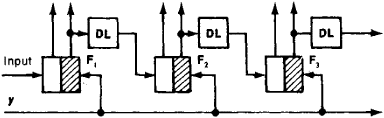
A simple example of a register is the three-bit shift register using flip-flops (F) that is shown in Figure 1. The input signal arrives at Ft. Suppose the signal has the value 1; Ft is then set in the 1 state. To shift the contents of the register to the right, the shift control signal y is fed to all three flip-flops simultaneously. The flip-flops that were in the 1 state are changed to the 0 state. From each of these flip-flops an output signal is sent that passes through a delay line and then sets the immediately following flip-flop in the 1 state. In this way, all 1’s recorded in the register are shifted one bit to the right.
The operation of a register is evaluated chiefly in terms of its speed, which is the switching time of its storage elements.
REFERENCES
Richards, R. K. Elementy i skhemy tsifrovykh vychislitel’nykh mashin. Moscow, 1961. (Translated from English.)Kagan, B. M., and M. M. Kanevskii. Tsifrovye vychislitel’nye mashiny i sistemy, 2nd ed. Moscow, 1973.
L. N. STOLIAROV