virtual reality
Virtual reality

virtual reality
[¦vər·chə·wəl rē′al·əd·ē]Virtual reality
A form of human-computer interaction in which a real or imaginary environment is simulated and users interact with and manipulate that world. Users travel within the simulated world by moving toward where they want to be, and interact with things in that world by grasping and manipulating simulated objects. In the most successful virtual environments, users feel that they are truly present in the simulated world and that their experience in the virtual world matches what they would experience in the environment being simulated. This sensation is referred to as engagement, immersion, or presence, and it is this quality that distinguishes virtual reality from other forms of human-computer interaction. See Human-computer interaction
When a user interacts with a virtual environment, the computer-generated graphics display must be updated with each turn of the head or movement of the hand. The virtual environment must be able to generate and display realistic-looking views of the simulated world quickly enough that the interaction feels responsive and natural. See Computer graphics
Hardware
Virtual reality relies on a variety of specialized input and output devices to achieve this sense of natural interaction.
The most important of the input devices used in a virtual environment, a tracker is capable of reporting its location in space and its orientation. Tracking devices can be optical, magnetic, or acoustic. A tracker is sometimes combined with a traditional computer input device, such as a mouse or a joystick. See Computer peripheral devices
An attempt to provide a truly natural input device, the data glove is outfitted with sensors that can read the angle of each of the finger joints in the hand. Wearing such a glove, users can interact with the virtual world through hand gestures, such as pointing or making a fist. See Strain gage
The real-world visual experience is approximated in virtual environments by using stereoscopic displays. Two views of the simulated world are generated, one for each eye, and a stereoscopic display device is used to show the correct view to each eye.
Applications
Virtual reality can be applied in a variety of ways. In scientific and engineering research, virtual environments are used to visually explore whatever physical world phenomenon is under study. Training personnel for work in dangerous environments or with expensive equipment is best done through simulation. Airplane pilots, for example, train in flight simulators. Virtual reality can enable medical personnel to practice new surgical procedures on simulated individuals. As a form of entertainment, virtual reality is a highly engaging way to experience imaginary worlds and to play games. Virtual reality also provides a way to experiment with prototype designs for new products. See Aircraft design, Computer-aided design and manufacturing
virtual reality
1. <application> Computer simulations that use 3D graphics and devices such as the data glove to allow the user to interact with the simulation.
2. <games> A form of network interaction incorporating aspects of role-playing games, interactive theater, improvisational comedy, and "true confessions" magazines. In a virtual reality forum (such as Usenet's news:alt.callahans newsgroup or the MUD experiments on Internet and elsewhere), interaction between the participants is written like a shared novel complete with scenery, "foreground characters" that may be personae utterly unlike the people who write them, and common "background characters" manipulable by all parties. The one iron law is that you may not write irreversible changes to a character without the consent of the person who "owns" it, otherwise, anything goes.
See bamf, cyberspace.
virtual reality
A computer-generated reality that projects the user into a 3D space. Using a stereoscopic headset that provides a completely immersive experience, the virtual reality (VR) system is operated by the user's head and hand movements or a physical control unit, the latter commonly used with virtual reality games. In the early days of VR, data gloves tethered by wires to a computer were used to track hand gestures.The very first virtual reality systems were created for pilot and astronaut training, employing a physical housing that looks like the inside of a cockpit. Extremely costly and still being used, they provide a totally realistic experience that simulates taking off, flying and landing (see flight simulator).
Like Real Life
When people wear ordinary non-VR video goggles, turning their head horizontally or vertically changes nothing (see video headphones). However, just as in real life, when people move their head with a VR headset, the view changes. VR headsets are either entirely self-contained units or a device that contains the user's smartphone (see VR headset, Oculus, Samsung Gear VR, Daydream VR and Google Cardboard).
Virtual Reality vs. Augmented Reality
"Virtual" reality is an entirely generated environment, whereas "augmented" reality creates images or video in space in front of the user or off to the side (see augmented reality). See virtual reality locomotion, social VR, metaverse, 3D visualization, virtual world, head mounted display, 6DOF, cyberspace, VRML and Second Life.
 |
| VR at the Dentist |
|---|
| In the late 1990s, this VR system kept children entertained at the dentist. Using a game controller, this boy was manipulating the scenes. (Image courtesy of I-O Display Systems.) |
 |
| Spatially Immersive Systems |
|---|
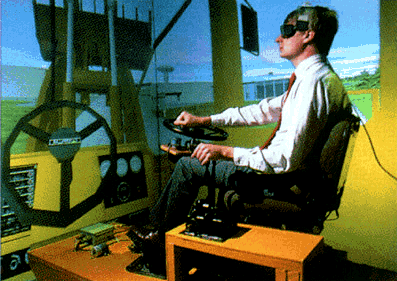
| In the early 1990s, Fakespace Systems' CAVE products were developed by the Electronic Visualization Lab at the University of Illinois. These examples simulate a new train station (top) for observation and a Caterpillar bulldozer for training (below). The steering wheel on the left meets the real wheel on the right in virtual space. (Images courtesy of Mechdyne Corporation, www.mechdyne.com) |
 |
| Spatially Immersive Systems |
|---|
| In the early 1990s, Fakespace Systems' CAVE products were developed by the Electronic Visualization Lab at the University of Illinois. These examples simulate a new train station (top) for observation and a Caterpillar bulldozer for training (below). The steering wheel on the left meets the real wheel on the right in virtual space. (Images courtesy of Mechdyne Corporation, www.mechdyne.com) |
 |
| Virtual Reality in the 1950s |
|---|
| In 1957, Morton Heilig created the first fully immersive system. Not only did the Sensorama have 3D and stereo sound, it included smell, seat vibrations and wind to enhance the illusion. (Image courtesy of Minecraftpsyco.) |