NAND flash
The type of flash memory in a solid state drive (SSD), USB drive and memory card. NAND flash is used for storage, while NOR flash supports program execution. The NAND and NOR designations actually refer to the logic circuits on the chips (for more details, see flash memory and logic gate).2D NAND - Limitations
Traditional flash memory has a single layer of cells, known as "2D planar NAND." As manufacturers shrank the cells and cell walls to increase storage density, fewer electrons resided in each cell, and leakage would occur. In addition, storing two and three bits in a single cell made ever smaller cells increasingly problematic (see MLC).
3D NAND - The Solution
Instead of making cells smaller, starting in 2013, Samsung began stacking layers of cells on top of one another. Other manufacturers followed.
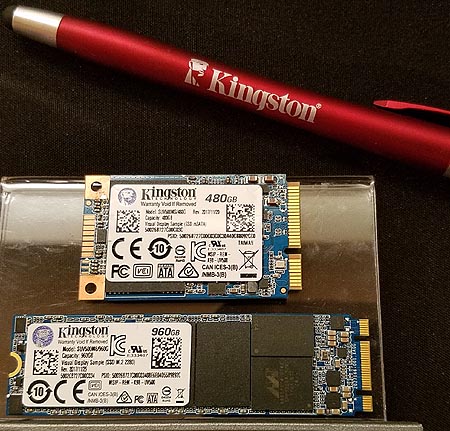 |
| 3D NAND Solid State Drives (SSDs) |
|---|
| In 2018, Kingston Technology announced 64-layer, triple level 3D NAND SSDs in three form factors: 2.5" SATA SSDs up to 1.9TB, mSATA SSDs up to 480GB (top) and M.2 SSDs up to 960GB (bottom). The M.2 interface supports both SATA and PCI Express. See SATA, mSATA and PCI Express. |
Copyright © 1981-2025 by The Computer Language Company Inc. All Rights reserved. THIS DEFINITION IS FOR PERSONAL USE ONLY. All other reproduction is strictly prohibited without permission from the publisher.