Corticosteroids
biologically active tetracyclic compounds manufactured by the adrenal cortex.
More than 40 compounds have been isolated from the adrenals. Eight of these are active, that is, they can reproduce the effect of adrenocortical extract, known as cortine naturelle (first obtained in 1927). Chemically, the active corticosteroids are pregnane derivatives containing the Δ4-3-keto- and 20-keto-21 hydroxy groups and with oxygen substitutes at the 11C, 17C, or 18C atom. True adrenal hormones include the mineralocorticoid aldosterone, which mostly regulates the metabolism of K+ and Na+ ions; the glucocorticoid hydrocortisone, or cortisol, which regulates carbohydrate metabolism; and corticosterone (17-deoxyhydrocortisone), which performs both of these functions. Cortexone (11-deoxycorticosterone) is a mineralocorticoid. Cortisone is a glucocorticoid. The corticosteroids also participate in the regulation of protein metabolism and fat metabolism. A corticosteroid deficiency results in Addison’s disease. The symptoms of the Itsenko-Cushing syndrome appear when the same hormones are in excess.
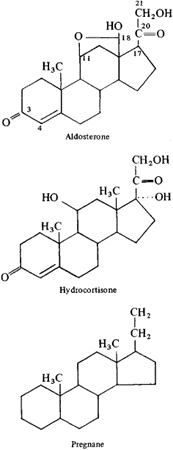
The formation, metabolism, and mode of excretion of corticosteroids are species-specific. In the human body, 15–25 mg of hydrocortisone, 1–5 mg of corticosterone, and 0.1–0.2 mg of aldosterone are manufactured daily. In some animals (for example, monkeys, sheep, and guinea pigs) the adrenal cortex produces mainly hydrocortisone. In others (rabbits and rats) it produces mostly corticosterone. Cholesterol is a precursor in the biosynthesis of the corticosteroids. The secretion of corticosteroids is regulated by adrenocorticotropic hormone, which is produced by the pituitary. Some of the corticosteroids in the blood are bound to plasma proteins. They are inactivated in the liver by partial reduction and binding by glucuronic and sulfuric acids. The corticosteroids and their metabolic products are rapidly excreted from the body, mainly with urine.
The corticosteroids are used in substitution therapy and as anti-inflammatory and antiallergic agents in the treatment of many diseases. Synthetic dehydro, hydroxy, halogen, and methyl derivatives of the corticosteroids (prednisone, dexamethazone, triamcinolone, Synalar) have also found practical application, since they are much more active biologically and produce fewer side effects.
REFERENCES
Iudaev, N. A. Biokhimiia steroidnykh gormonov kory nadpochechnikov. Moscow, 1956.Komissarenko, V. P. Gormony kory nadpochechnikov i ikh roV vfiziologicheskikh i patologicheskikh protsessakh organizma. Kiev, 1956.
Fieser, L., and M. Fieser. Steroidy. Moscow, 1964. (Translated from English.)
M. A. KREKHOVA